
Buy Now or Wait? Ontario Housing Outlook for 2026
October 1, 2026
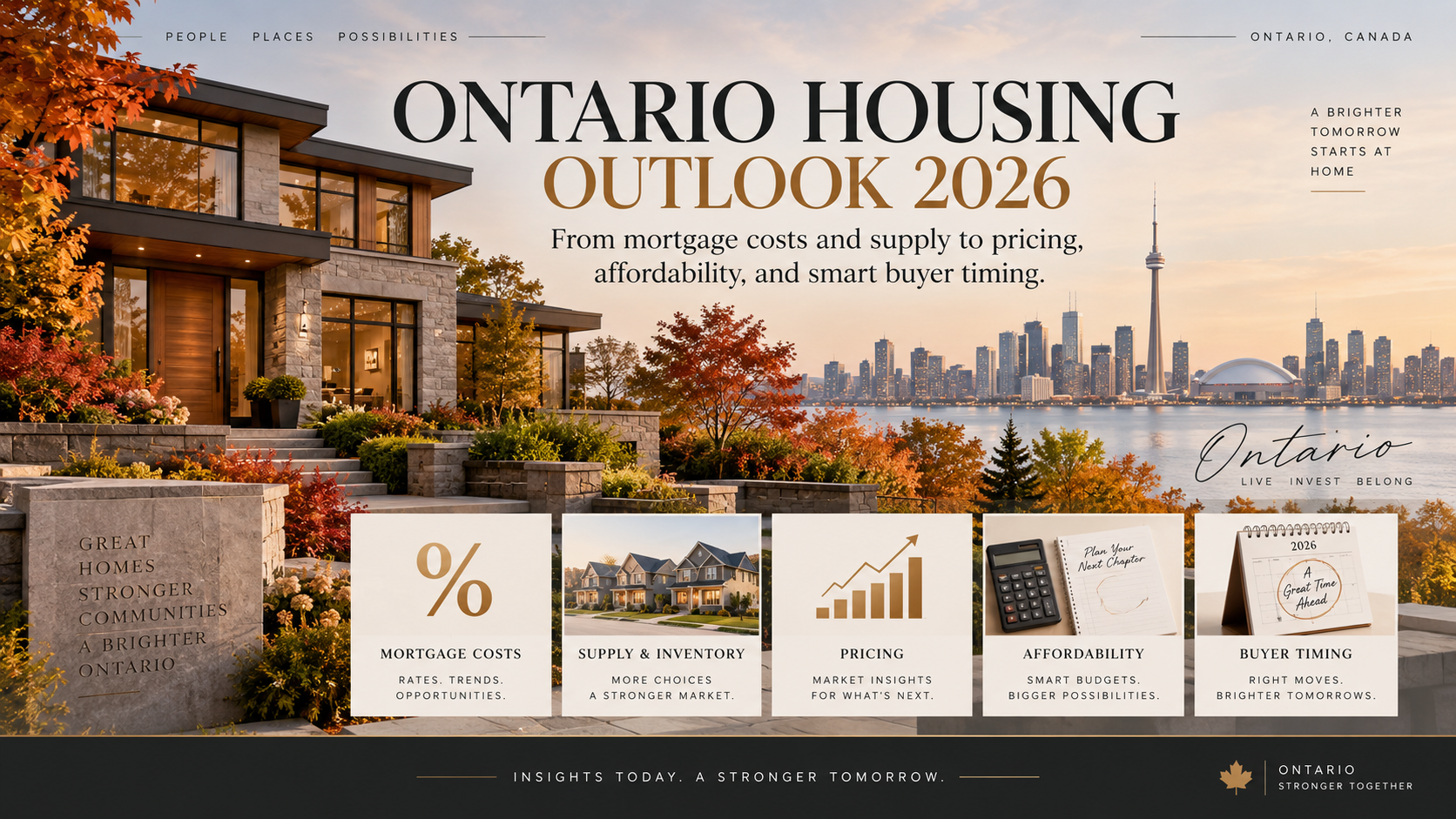

Introduction
For Ontario home buyers, the question is rarely just whether prices will move up or down. It is whether buying now fits their budget, lifestyle, and long-term plans better than waiting. In 2026, that decision is shaped by a market still balancing affordability pressure, constrained supply in many communities, changing mortgage conditions, and uneven demand across property types. Toronto and the surrounding region may behave very differently from Ottawa, Hamilton, London, Kitchener-Waterloo, or smaller Ontario markets.
A useful housing outlook is not a prediction of one exact price. It is a framework for making a sound decision under uncertainty. Buyers who understand their carrying costs, local inventory, and negotiating position can act with more confidence—whether they purchase this year or use the time to prepare.
What Is Shaping Ontario’s Market in 2026?
Ontario’s housing market is being pulled in opposing directions. On one side, high purchase prices and borrowing costs continue to limit what many households can afford. On the other, household formation, immigration, employment hubs, and a persistent shortage of well-located homes support underlying demand. The result is likely to be a market where conditions vary sharply by neighbourhood and price range rather than moving in one uniform direction.
- Mortgage rates: Even modest changes in fixed or variable rates can materially affect qualification amounts and monthly payments.
- Housing supply: New listings, completed construction, and purpose-built rental supply influence both competition and pricing power.
- Affordability: Income growth has not fully erased the gap created by years of rapid home-price gains, especially in the Greater Toronto Area.
- Population and jobs: Areas with transit access, major employers, schools, and amenities tend to retain demand even when buyers become cautious.
- Policy and lending rules: Mortgage qualification, zoning changes, first-time buyer programs, and municipal development processes can affect market behaviour.
This means headlines about “Ontario prices” should be treated carefully. A two-bedroom condominium with several comparable listings can give a buyer more leverage than a family-sized detached home near a strong school catchment. The local listing-to-sale ratio, days on market, and number of competing offers are often more useful than a provincial average.
The Case for Buying Now
Buying in 2026 can make sense for households that have stable income, a sufficient down payment, manageable debt, and a plan to stay put for several years. The best reason to buy is not the belief that a home will immediately rise in value. It is that the home meets a real need and the monthly cost remains comfortable through ordinary financial setbacks.
A less frenzied market may create opportunities that were difficult to find during peak competition. Buyers may have more time for inspections, financing conditions, and thoughtful comparison shopping. Sellers whose properties have been listed for longer may be more open to price discussions, flexible closing dates, or inclusions such as appliances and parking. In some segments, new-build or resale buyers may also find a wider choice of layouts and locations.
“The right purchase is one that still works if rates, repairs, or life plans do not unfold exactly as expected.
Buyers should test affordability beyond the lender’s approval number. Include property taxes, condo fees where applicable, utilities, insurance, maintenance, commuting, and a reserve for repairs. For a condominium, review the status certificate and reserve fund. For a house, budget for items such as roofing, heating and cooling, drainage, and unexpected maintenance. A lower offer price does not help if the total ownership cost creates constant financial strain.
The Case for Waiting
Waiting can be the smarter choice when the numbers are too tight, employment is uncertain, or a move is likely within the next few years. Home ownership has significant transaction costs: land transfer tax, legal fees, inspections, moving, potential repairs, and, eventually, selling costs. These expenses can make a short holding period expensive even if market values rise modestly.
A period of preparation can improve a buyer’s options. Paying down high-interest debt, building a larger down payment, correcting credit issues, and strengthening an emergency fund may lower the stress of ownership and improve mortgage qualification. Waiting also gives buyers time to learn target neighbourhoods, track comparable sales, and understand which property compromises they can accept.
However, waiting is not risk-free. If borrowing costs ease or confidence improves, more sidelined buyers may re-enter the market. That can increase competition for well-priced homes, particularly in supply-constrained neighbourhoods. Renters should compare the likely cost of continuing to rent with the true after-tax cost of ownership, rather than assuming either path is automatically cheaper.
Affordability: Focus on Payments, Not Just Prices
A home’s sticker price is only one part of affordability. The mortgage payment depends on the purchase price, down payment, interest rate, amortization period, and mortgage type. A change in rate can have a larger monthly impact than a small reduction in price. Before making an offer, ask a mortgage professional to show several payment scenarios, including a renewal-rate stress test and the effect of different down-payment amounts.
- Set a payment ceiling that leaves room for savings, retirement contributions, and everyday life.
- Keep a cash reserve after closing instead of using every dollar for the down payment.
- Review mortgage features, including prepayment privileges, portability, penalties, and renewal flexibility.
- Do not overlook location costs, such as transit, parking, fuel, childcare access, and commute time.
- Use comparable sold properties—not only asking prices—to evaluate whether a listing is realistically priced.
Where Buyer Opportunities May Appear
Opportunities in 2026 may be more segment-specific than market-wide. Condominiums with many nearby alternatives can offer selection and negotiating room, although buyers must carefully assess fees, building management, and future special-assessment risk. Townhomes and modest detached homes may remain competitive where they offer space for families and access to established amenities. Homes needing cosmetic updates can also be attractive when buyers have realistic renovation budgets and do not confuse cosmetic work with major structural issues.
Look beyond the most obvious postal codes. Communities with improving transit, employment access, hospitals, post-secondary institutions, or revitalizing downtowns can offer different value propositions than the GTA core. But do not buy solely on a future infrastructure promise. Evaluate current livability, resale demand, flood risk, property condition, local taxes, and the number of comparable homes likely to compete with yours when it is time to sell.
A Practical Decision Checklist
Instead of trying to call the market perfectly, use a simple decision checklist. First, determine whether you expect to own the home long enough to absorb transaction costs. Second, obtain a current mortgage pre-approval and understand that it is a starting point, not a guarantee. Third, build a full monthly ownership budget and test it against a higher-rate scenario. Finally, work with qualified legal, mortgage, and real estate professionals to review the details of any specific purchase.
If the answer is yes on stability, cash reserves, and payment comfort, 2026 may offer a reasonable environment to buy carefully and negotiate well. If the answer is no, waiting is not failure—it is a financial strategy. Use the time to strengthen your position so that a future purchase is based on readiness rather than fear of missing out.
Conclusion
Ontario’s 2026 housing outlook is unlikely to deliver one simple answer for every buyer. Affordability remains a central challenge, but changing market conditions can create room for disciplined buyers to find value. The strongest approach is to make a personal, local, and numbers-driven decision. Buy when the home, budget, and time horizon align; wait when they do not. In either case, careful preparation will matter more than a perfect market-timing prediction.
Comment (0)
Leave a comment
Your email address will not be published. Required fields are marked *


© 2026 A1 AI Agents Inc. All rights reserved.
Information presented is believed to be accurate but is not guaranteed and should be independently verified. Data has been obtained in part from the Toronto Regional Real Estate Board (TRREB) and is provided exclusively for consumers with a genuine interest in the purchase, sale, or lease of real estate. Any unauthorized use, reproduction, or distribution of this material, in whole or in part, is strictly prohibited.